| Age | Thousands of years old |
| Name | The Great Ring |
| Origin | Unknown ancient civilization |
| Description | Extensive network of ancient stone structures |
| Significance | Sophisticated engineering, widespread influence on early human societies |
| Proposed Purposes | Global communication and power system • Astronomical observatory and calendar • Unknown advanced purpose |
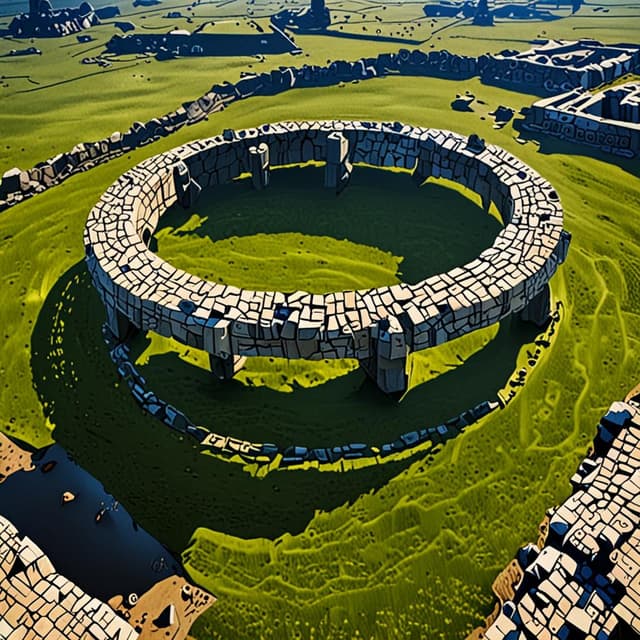
The "Great Ring" refers to a network of colossal stone structures and architectural complexes found across multiple continents, including North America, South America, Africa, Europe, and Asia. First systematically documented and studied in the 19th century, the Great Ring has puzzled researchers ever since, with its origins, purpose and underlying technology still shrouded in mystery.
The Great Ring was first brought to widespread attention in the 1820s, when European explorers and archaeologists began documenting enormous stone monoliths, circular formations, subterranean tunnels, and other enigmatic structures in remote regions around the world. Early studies suggested these sites predated any known historical civilizations, confounding conventional timelines of human development.
As more sites were uncovered, researchers began to note common architectural features, alignments, and engineering principles linking the disparate structures, hinting at a once-unified system or network. This led to the hypothesis of the "Great Ring" - a global network of interconnected sites built by an advanced ancient culture.
Scholars have proposed a wide range of theories to explain the purpose and origins of the Great Ring, though none have been conclusively proven:
Astronomical Observatory: Some believe the Ring's precisely aligned structures, such as the Nazca Lines in Peru and Stonehenge in England, functioned as massive astronomical calendars, possibly for religious or navigational purposes.
Power and Communication Grid: An influential hypothesis is that the Ring formed an electrical or energy transmission network, allowing for long-distance communication and the distribution of power or resources across the ancient world.
Cultural Diffusion: Others argue the Ring represents the spread of a single, highly advanced ancient civilization that shared architectural and technological knowledge across the globe.
Alien Contact: More speculative theories suggest the Ring was built with the help of extraterrestrial beings or advanced non-human intelligence.
Regardless of their origins, the sheer scale, complexity and global distribution of the Great Ring structures point to capabilities far beyond those of known ancient civilizations.
Some of the most significant and well-known Great Ring sites include:
Many of these sites also include extensive underground tunnel systems, sophisticated hydraulic engineering, and advanced stonework suggesting sophisticated tools and construction methods.
The Great Ring appears to have profoundly influenced the development of some of the earliest complex societies and urban centers in human history. Evidence suggests the structures were used for purposes ranging from astronomical observation to resource distribution, religious rituals, and long-distance communication.
Sites associated with the Great Ring have been found to predate many known ancient civilizations, including the Sumerian, Egyptian, Indus Valley, and Mesoamerican cultures. This has led to speculation that the Ring may have played a formative role in catalyzing the rise of these early urban societies and technologies.
The Great Ring continues to captivate archaeologists, historians, and the public imagination, with new discoveries and research constantly expanding our understanding. However, many fundamental questions about its origins, mechanisms and true purpose remain unanswered.
Cutting-edge dating techniques, remote sensing technologies, and interdisciplinary collaborations have shed light on certain aspects of the Ring. Yet its overarching story and the identity of its creators persist as some of the greatest unsolved puzzles of human history. Unraveling the full mysteries of the Great Ring may yield transformative insights into the capabilities and origins of ancient civilizations.
